


Page 60 - thesis_biby_tharayil
P. 60
50
                               1
                                                                                     2
                        world”.  The four missions recognized by Familiaris Consortio  point to the
                        one principle duty of the family: being at the service of human life, be it at
                                                            3
                        the  quantitative  or  qualitative  level.   Most  of  the  family  customs  of  the
                        Southist community, directly or indirectly, point to this principal mission of
                        the Christian family (Ch. 3.7 and Ch. 3.8). A cursory look at these customs,
                        with  the  symbols  used  in  them,  concurs  with  the  idea  of  family  as  the
                        Sanctuary  of  Life.  This  study  will  now  consider  in  detail  the  specific
                        missions of the Christian family as envisaged by the magisterium of Pope
                        John Paul II and the particular Southist customs that imply those missions.
                        The  study  will  minimally  include  other  documents  of  the  Church  that
                        support this teaching of the Pope.

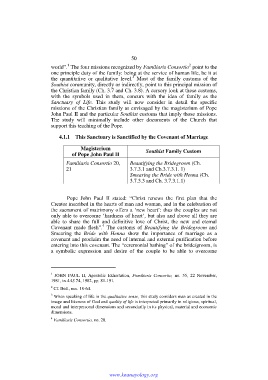
                           4.1.1  This Sanctuary is Sanctified by the Covenant of Marriage

                                     Magisterium                  Southist Family Custom
                                 of Pope John Paul II
                              Familiaris Consortio 20,     Beautifying the Bridegroom (Ch.
                              21                           3.7.3.1 and Ch.3.7.3.1. 1)
                                                           Smearing the Bride with Henna (Ch.
                                                           3.7.3.3 and Ch. 3.7.3.1.1)


                               Pope  John  Paul  II  stated:  “Christ  renews  the  first  plan  that  the
                        Creator inscribed in the hearts of man and woman, and in the celebration of
                        the sacrament of matrimony offers a ‘new heart’: thus the couples are not
                        only able to overcome ‘hardness of heart’, but also and above all they are
                        able  to  share  the  full  and  definitive  love  of  Christ,  the  new  and  eternal
                                               4
                        Covenant  made  flesh”.   The  customs  of  Beautifying  the  Bridegroom  and
                        Smearing  the  Bride  with  Henna  show  the  importance  of  marriage  as  a
                        covenant and proclaim the need of internal and external purification before
                        entering into this covenant. The “ceremonial bathing” of the bride/groom, is
                        a  symbolic  expression  and  desire  of  the  couple  to  be  able  to  overcome


                        1   JOHN  PAUL  II,  Apostolic  Exhortation,  Familiaris  Consortio,  no.  55,  22  November,
                        1981, in AAS 74, 1982, pp. 81-191.
                        2  Cf. Ibid., nos. 18-64.
                        3
                         When speaking of life in the qualitative sense, this study considers man as created in the
                        image and likeness of God and quality of life is interpreted primarily in religious, spiritual,
                        moral and interpersonal dimensions and secondarily in its physical, material and economic
                        dimensions.
                        4
                         Familiaris Consortio, no. 20.


                                                  www.knanayology.org

